Evidence into action: a global conversation on access to justice
How can we turn evidence into meaningful improvements in access to justice?
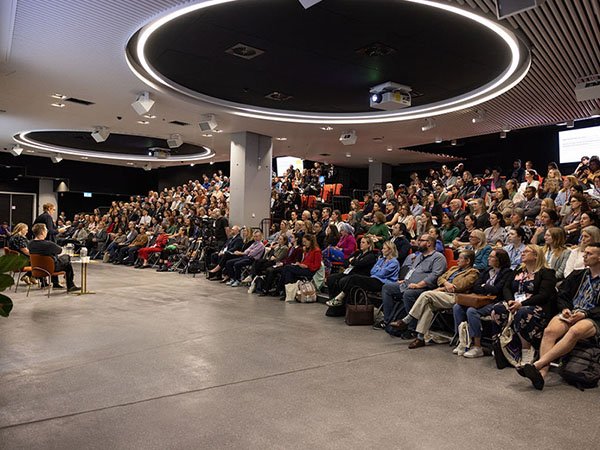
The 2026 International Access to Justice Forum brought over 350 delegates from 32 countries to Melbourne (Naarm) for three days of discussion, connection and collaboration.
VLF hosted the Forum in partnership with Monash University, bringing together researchers, practitioners, policymakers, justice leaders and people with lived experience around a common question: how can we turn evidence into meaningful improvements in access to justice?
The theme, Evidence and Action, proved particularly timely. Across three days, conversations explored what works, why it works, and how research, experience and collaboration can help create justice systems that better respond to people’s needs.
And judging by the reflections shared since the Forum, people left Melbourne with much more than notes from a conference. They left with new ideas, new relationships and renewed energy for the work ahead.
Evidence is only the beginning
One of the strongest themes to emerge was that producing good evidence is not enough. The challenge is translating what we know into better services, policies and systems.
That was reflected across a program connecting research with lived experience, frontline practice and system reform.
The Law and Justice Foundation of NSW, whose team presented work on regional access to justice, unmet legal need, service data and pathways from coronial recommendations to reform, identified one of the questions running through the Forum: do we pursue incremental change now, or reimagine more boldly?
Its conclusion was that justice systems need both.
That idea also emerged from the plenary featuring Rebecca Plummer, Sachin Malhan and Martin Gramatikov. Their perspectives highlighted user-centred service design, hyperlocal and community-driven solutions, multidisciplinary legal ecosystems and an important message: meaningful progress does not always require complete systemic overhaul. Smaller, immediate changes can improve people’s experiences and outcomes now.
It is a useful reminder that ambitious reform and practical action need not be competing ideas.
“Everybody is an agent; everybody can contribute to change” -Rebecca Plummer
Collaboration creates the conditions for change
If evidence was one recurring theme, collaboration was another.
Ahead of the Forum, Dr Rebekah Farrell, Executive Director, Victoria Law Foundation, captured the idea simply: “access to justice is not a challenge that any one organisation, profession or jurisdiction can solve alone”. Progress depends on sharing evidence, listening across boundaries and maintaining a focus on the experiences of people who need help.
The significance of those relationships was echoed throughout the Forum.
Reflecting on examples from India and Aotearoa New Zealand, Peter Noble noted how bringing together people and organisations around shared goals builds trust and helps create the conditions for change. Our co-host, Professor Steven Vaughan, highlighted not only the quality of the research and presentations but also the breadth of the international community assembled in Melbourne.
“Relationship building is critical when building capital for change. This is new work … to imagine a community of leaders who can have a new vision for justice” -Sachin Malhan
Keeping people at the centre
Across the Forum, participants returned repeatedly to what person-centred justice means in practice.
For some, that meant looking at how services are designed. For others, it involved examining some of the difficult questions that arise when different disciplines work together to support people experiencing legal and other problems.
Victorian Law Reform Commission, for example, used the Forum to invite discussion about legal professional privilege in integrated services, where lawyers, social workers and financial counsellors may work collaboratively to respond to complex needs.
Women’s Legal Service Victoria added its perspective, highlighting the importance of multidisciplinary assistance for the women and non-binary people it supports and advocating for legal privilege arrangements that better recognise integrated practice.
These exchanges demonstrated one of the Forum's strengths: creating space for evidence, policy, frontline experience and different perspectives to meet.
Learning across borders
The international reach of the Forum brought another dimension to those conversations.
Speakers came from around the world – from Bangladesh to Guyana, from Ethiopia to India, from Kiribati to Canada – including Martin Gramatikov, Sachin Malhan, Andrew Pilliar, Naomi Creutzfeldt and many others.
The opportunity to compare approaches across jurisdictions also showed that access-to-justice challenges may take different forms in different places, but many of the underlying questions are shared.
How do we understand legal need? How do we know whether an intervention works? What should we measure? How can services be more responsive to the people using them? And how can evidence move beyond identifying problems to helping solve them?
The Forum did not suggest there are simple answers. Its value was in bringing together people prepared to examine those questions from different perspectives.
First Nations justice at the heart of the conversation
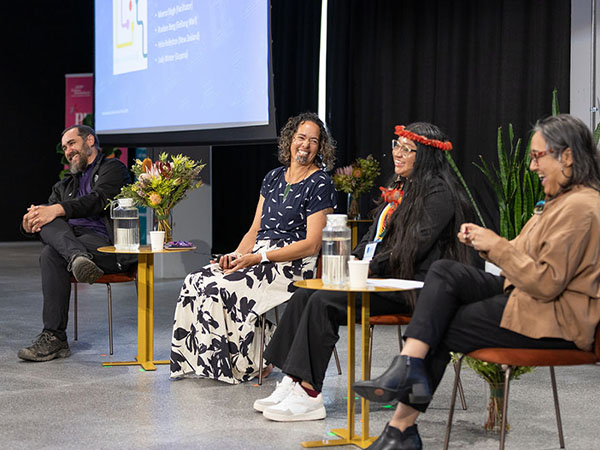
First Nations justice was an important part of the Forum from its opening. Meena Singh facilitated the first session and framed the conversation around the ideal that “justice solutions need to be place-based … solutions need to be from the land up”.
During the first plenary, delegates heard from Rueben Berg (co-chair of the First Peoples’ Assembly of Victoria), Judy Winter (representing the South Rupununi District Council in Southern Guyana) and Hiria Rolleston (representing Community Law Centres Aotearoa NZ). Speaking on Indigenous Law: not just equity of access but equity of justice, their discussion focused on recognising that meaningful access to justice is strengthened through empowered communities, cultural identity and inclusive systems. As Rueben Berg stated, ‘the law is too precious to be left to the lawyers.”
Inspiring the next generation
The Forum's impact was not limited to established researchers and justice leaders.
Reflections collected after the event included student volunteer Natalie Hermiz, who described gaining a deeper understanding of barriers to justice and greater motivation for her future in law. Her response is one example of the Forum's wider value in exposing emerging professionals to the people, ideas and challenges shaping access to justice.
That matters because the strength of the access-to-justice community ultimately depends on the next generation being part of the conversation.
What comes next
Perhaps the strongest measure of a Forum like this is not what happens during three days together, but what happens afterwards.
The conversations generated new connections, tested ideas and exposed participants to approaches being developed across Australia and around the world.
The public response has been strongly positive. Participants have described the Forum as collegial, thought-provoking and energising, and our co-host, Professor Steven Vaughan, went so far as to describe it as perhaps the best conference he had attended.
But success is about more than positive feedback.
It can be seen in the questions people are still discussing, the research being shared, the relationships strengthened across jurisdictions and disciplines, and the practical ideas participants have taken back to their own organisations and communities.
The Forum demonstrated what becomes possible when evidence and experience are brought together with a willingness to act.
The gathering in Melbourne may be over, but the work continues: sharing what we know, testing what works, learning from each other and turning evidence into action that can make justice more accessible for everyone.
The next International Access to Justice Forum will be held in Victoria, Canada in 2027.
Materials and recorded sessions will be made available on Victoria Law Foundation’s website in late November, so that the exchange can reach beyond those able to attend in person.
Publications
Subscribe to our Newsletter
Better understanding the extent of unmet legal and related need across climate and disaster impacted communities.

An editorial from Dr Rebekah Farrell, Executive Director, Victoria Law Foundation.

Helping young people overcome some of the barriers on their way to achieving Australian citizenship.

Respond to legal need
Major Grants offer up to $100,000 for civil legal projects that help organisations better understand and support the legal needs and capabilities of Victorians.