Measure for Measure: A People-Centred Approach to Tailoring Justice
Measure for Measure is foundational research that aimed to map and understand a range of justice initiatives from across Victoria. It is an effort to identify the common elements of success in responding to legal need and capability, and to discuss what that means for practice, evaluation, and better outcomes at a range of levels.

Publication details


Authors




Across Victoria, organisations are designing and implementing innovative, tailored approaches to meet everyday legal need. Measure for Measure brings these pockets of practice together to make an important contribution to the question: what works to meet people’s legal needs? And just as important: how can we know?
Through surveys and in-depth interviews, 66 initiatives from 31 organisations were explored, covering diverse geography, demographics and service types, including legal assistance services, courts, pro bono partnerships, and other justice sector activity.
The analysis identifies common elements of effective practice in these initiatives and organises them into a People-Centred Justice Model to help inform how the sector designs, measures, and understands its work. The report also explores the potential and challenges in sustaining and scaling these initiatives—critical for the broader adoption of successful practice.
The report expands on the concept of the justice ecosystem—recognising that there is great interconnection, and that an aggregated view of activity and experience will pay significant dividends in systematically addressing legal need and capability across Victoria.
Citation
The suggested citation for this document is:
McAloon, B., Rychner G., Mansfield Y. & Burgess B. (2026). Measure for Measure: A People-Centred Approach to Tailoring Justice. Melbourne: Victoria Law Foundation.
Downloads
Measure for Measure is foundational research that aimed to map and understand a range of justice initiatives from across Victoria. It is an effort to identify the common elements of success in responding to legal need and capability, and to discuss what that means for practice, evaluation, and better outcomes at a range of levels.

Measure for Measure draws on the knowledge and experience of justice practitioners across Victoria to explore what works to meet legal need—and what more is needed.

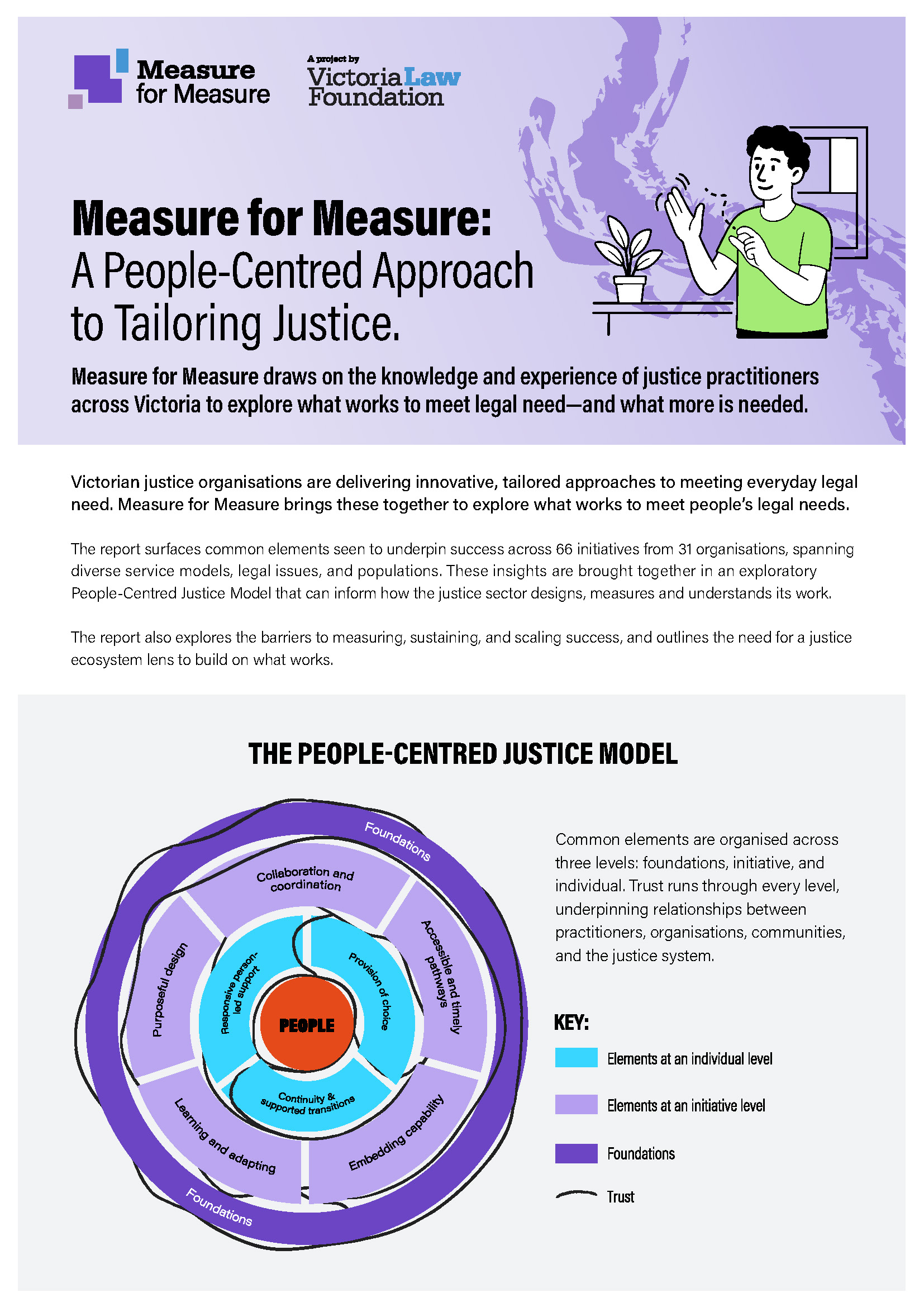
As an exploratory model, this framework brings together common elements that participants identified as making a difference in meeting legal need.

Key findings
People-Centred Justice Model
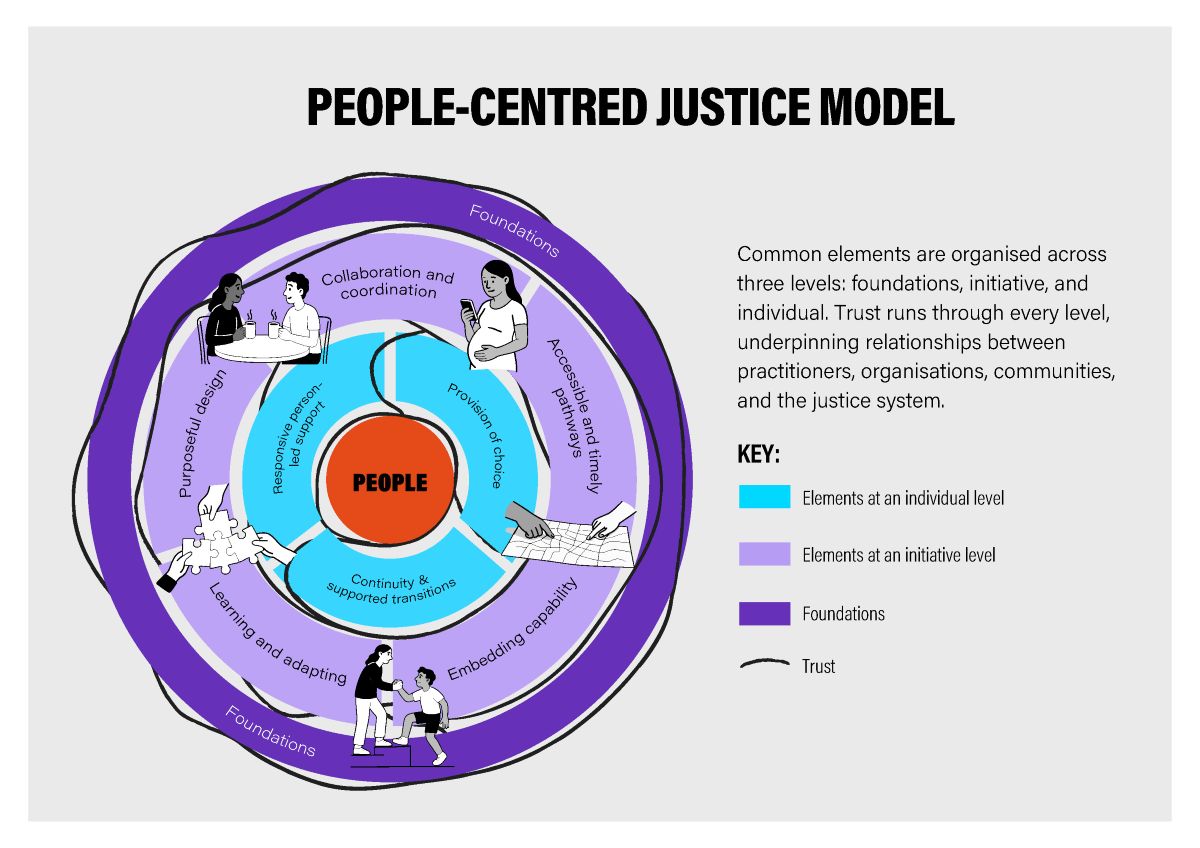
The research bridges the growing international research discourse on people-centred justice, with practices on the ground in Victoria. People-centred justice shifts the focus in systems and processes from institutions to individuals—their needs, capabilities, and experience.
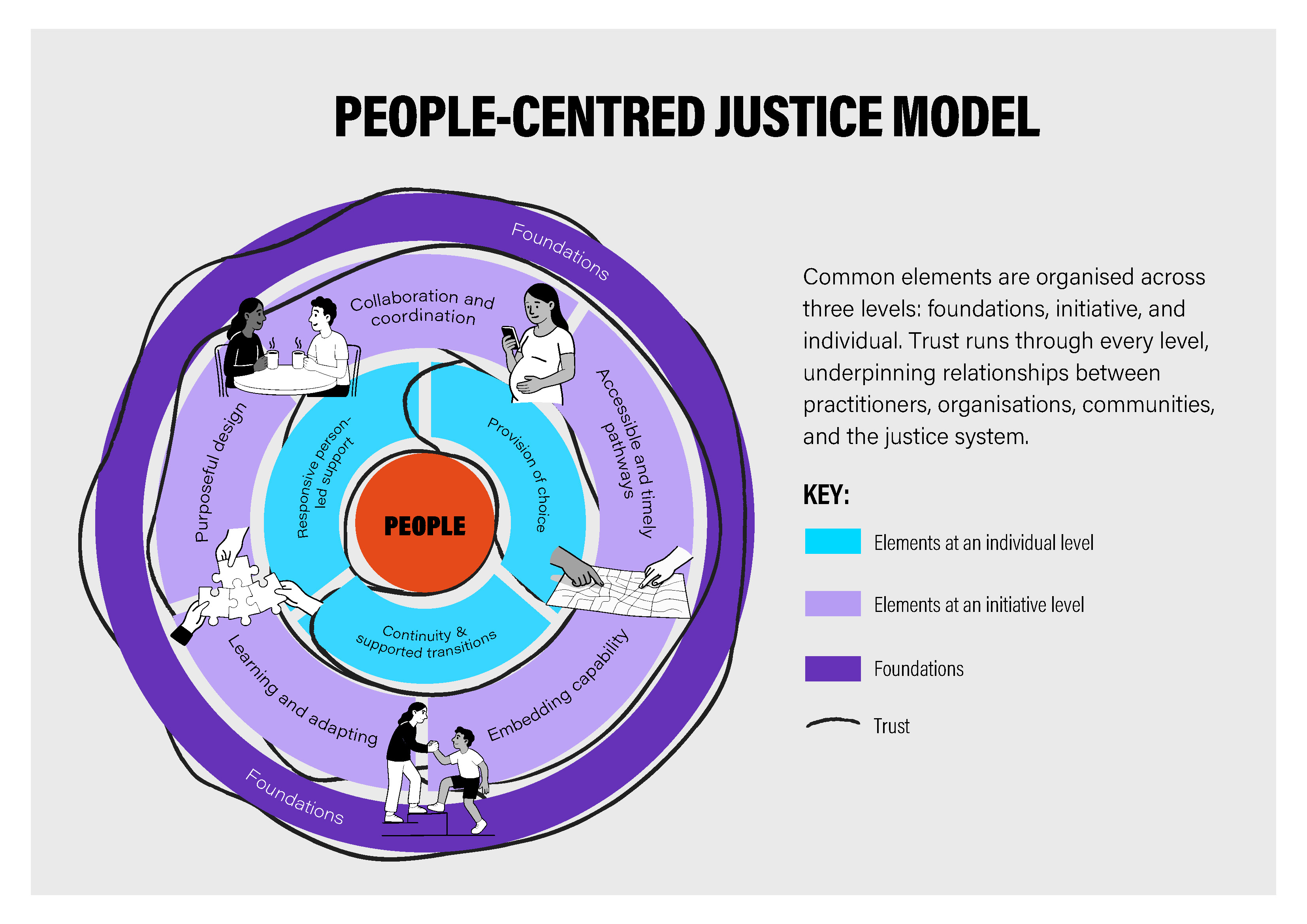
The exploratory People-Centred Justice Model at the heart of Measure for Measure was built from an analysis of what participating practitioners working in the 66 initiatives identified as underpinning success. The research identified common elements associated with effective practice across diverse service models, legal issues and populations. The model provides a structured but flexible way of understanding how initiatives operate and what contributes to their effectiveness.
In the model, the elements practitioners identified as giving initiatives the best chance of success are organised across three levels:
Foundations
Organisational conditions:
- alignment with purpose and values
- leadership, trust, and culture
- the right people
- technology and digital infrastructure
- funding
Initiative level
How justice initiatives are designed and delivered:
- purposive design
- collaboration and coordination
- accessible and timely pathways
- embedding capability
- learning and adapting
Individual level
The way services engage with people:
- responsive person-led support
- provision of choice
- continuity and supported transitions
Trust is a consistent and unifying theme running through each level, a connective thread underpinning relationships between practitioners, organisations, communities, individuals, and the broader justice system.
Importantly, the model also recognises there is a spectrum of practice in the initiatives; from lighter-touch service, which enables greater reach; to high-resource, more intensive examples supporting a smaller number of clients, often with more complex needs.
The value of the exploratory model lies in creating a shared language and a common foundation to examine existing practice, guide the design of new initiatives, and, critically, structure the evaluation and research that will tell us more about what effectively works, for whom, and under what conditions.
Practitioners are putting people-centred justice into practice
The initiatives spanned a range of legal issues, populations and service models, and collectively reveal a shared commitment to tailoring responses to the needs and capabilities of individuals and communities.
Across the 66 initiatives, organisations were delivering services to a specific population or area of law, or both. Initiatives responded to diverse legal needs, including civil law, family law, and criminal matters; and supported Victorians facing financial disadvantage, experiencing or at risk of family violence, homelessness, migration challenges, and other forms of disadvantage. Family violence-related initiatives were most prevalent, with 71% of the initiatives targeting this area of law.
Elements of success are common across service types
Analysis of the participant responses generated a set of common elements seen to underpin initiative success, which was used to build the exploratory People-Centred Justice Model. The elements in the model were common across problem types, demographics and services, and robust enough to apply to highly diverse service provision, from intensive, integrated assistance to high-reach online initiatives. Consequently, the model can be reliably used to support service design and evaluation, and is a useful starting point from which to test other hypotheses.
Collaboration is a consistent feature of what practitioners described as working
Nearly two-thirds of initiatives (65%) involved one or more external partners. Participants noted that complex and compounding legal matters often benefited from a more interdisciplinary response. Research participants described collaborations with health providers, other legal services, community organisations, and other allied professionals as central to successfully reaching the people the initiatives were designed to serve.
Embedding trust is critical
Trust surfaced as a central feature of success in the studied initiatives, a common theme at every level of practice: between practitioners and service users, between partner organisations and personnel, and across the broader justice system. The findings consistently pointed to the critical role of trust in shaping what is effective and sustainable. Participants described trust as something that needs to be built and nurtured.
Building capability in people, practitioners and organisations
Across the research participants, building capability at every level was seen as key to effective practice. A core element of the People-Centred Justice Model was building the legal knowledge, skills and confidence of the service users, as well as growing the expertise of practitioners and the capability of their organisations.
Many of the participating initiatives placed explicit emphasis on developing legal capability, as a dedicated focus and through interactions which helped change people’s relationship with the law.
Practitioners also described how collaboration enhanced their own skills, and those of partners, creating more effective and sustainable ways of working.
Promising practice requires investment
Four out of five initiatives (79%) identified funding and resourcing as the most significant barrier to initiative success. There's also a lack of robust, consistent outcomes data, which crimps potential.
There is growing interest in evaluation, outcomes measurement and evidence-based practice, but many organisations face constraints in resources, capability, and infrastructure to embed this practice. Without dedicated resourcing, including for staffing, data collection, outcomes measurement and evaluation, the evidence needed to assess what works, compare interventions, or build compelling cases for investment, replication, and scaling is thin.
Sustainability and scalability remain ongoing challenges. Even where initiatives are identified as effective, they often struggle to secure ongoing funding or expand beyond pilot stages.
Without a stronger evidence base and more coordinated system-level support, promising practices risk remaining confined to localised contexts.
Fragmentation limits impact
Fragmentation remains a defining feature of the justice ecosystem. Much of the innovation and effort continues to occur in pockets, confined to individual projects and/or organisations. Systemic and effective strategies that target prevalent legal issues remain difficult to identify, let alone progress, and structural and funding constraints continue to limit the capacity to test, evaluate, maintain, and scale promising approaches. There are also limited mechanisms for sharing learning or coordinating efforts.
This fragmentation is reinforced by competitive and often short-term, project-based funding, which can discourage collaboration and frustrate long-term planning.
Implications and insights
The findings in Measure for Measure point to the importance of complementing initiative-level insight with a stronger understanding of the wider justice ecosystem. While individual initiatives may be effective in their own context, there is limited visibility of how they interact, where they align, and where gaps persist. There is also limited capacity to aggregate learning, compare approaches, and build a system-wide picture of effectiveness.
The findings make the case for an ongoing, coordinated, evidence-driven, and system-wide approach to access to justice.
Use and refine the model, including incorporating the perspectives of service users
The exploratory People-Centred Justice Model provides a useful foundation, but the proof will be in the pudding. We will need to understand how it has been received and applied in different service environments, and consequently, what refinements are needed to gauge its value across a range of initiative types, legal environments, and service contexts.
Critically, the model and its elements need to be tested with people at the centre of the model—those who seek legal help.
Develop people-centred justice data
The development and use of people‑centred justice data, including data that measures people’s needs, pathways, and outcomes across different cohorts, legal issues, and locations, needs to be prioritised. This includes system‑level, mixed‑methods and intersectional data, which is needed to assess what works for who, and to guide the design, scaling, and evaluation of people-centred justice approaches.
Build consistent, outcomes-focused measurement
Practitioners across the sector are wrestling with the same measurement questions, often in isolation. Investing in more consistent outcomes measurement, with a focus on people-centred measures and the capabilities, tools and systems to use them, would support a step-change in measurement practices. This would reduce duplication of efforts, enable comparison, and strengthen the collective evidence base that the sector currently lacks. This is critical to support the assessment of which justice initiatives work well.
Develop robust evidence on effective ‘dosages’
We need to understand how much ‘legal’ is enough. This study covered initiatives working at a wide range of ‘dosages’ of legal support—from information and education through to representation and integrated casework, but there is limited evidence about how much, what type and which combinations of legal support work for different people and problems.
Understanding which levels of support are effective for different people and legal problems is one of the most significant questions the sector can now pursue. In particular, better evidence on which lower-dose interventions, such as information, education and advice, work to effectively meet some legal need. Greater understanding of how much is enough could be revolutionary in the design, allocation and success of services.
Coordinate and build evidence of the ecosystem
Individual initiatives can only take the sector so far. The research points to the need for a more coordinated approach: sharing learning, fostering collaboration, aligning data practices, and identifying where the justice ecosystem is working well and where people are falling through the gaps.
Building an ecosystem view is needed to complement initiative-level insight, including how people enter and move through the ecosystem. This includes what service levels and supports they receive, where barriers and gaps arise, and what outcomes are achieved. Such information is vital to identify system-level opportunities that may exist to provide better access to just resolution through practices such as need and capability-based triage and referral.
This requires sustained leadership, resourcing, and commitment. Without coordinated action, piecemeal initiatives and evaluation risk continuing to generate fragmented insights that cannot be effectively scaled or translated into systemic reform.
Frequently asked questions
Publication resources
Related publications
You may be interested in these other research publications.
Explore how justiciable problems are experienced, what people do about them, and how they progress and conclude (if they conclude).
-20Volume-201_600x848_WEB.avif)
Examining the use and utility of administrative data in Victoria’s civil justice system.

Similar publications
You may be interested in these other research publications.
Investigating the interplay of disadvantage, legal need, and legal capability in Victorians experiencing legal problems.


Exploring the resolution and outcomes of Victorian's experience of family problems.

