Reframing justice
There are a few concepts that are surfacing increasingly in public discourse about justice here and overseas. If you’re not familiar, let me take you on a tour.
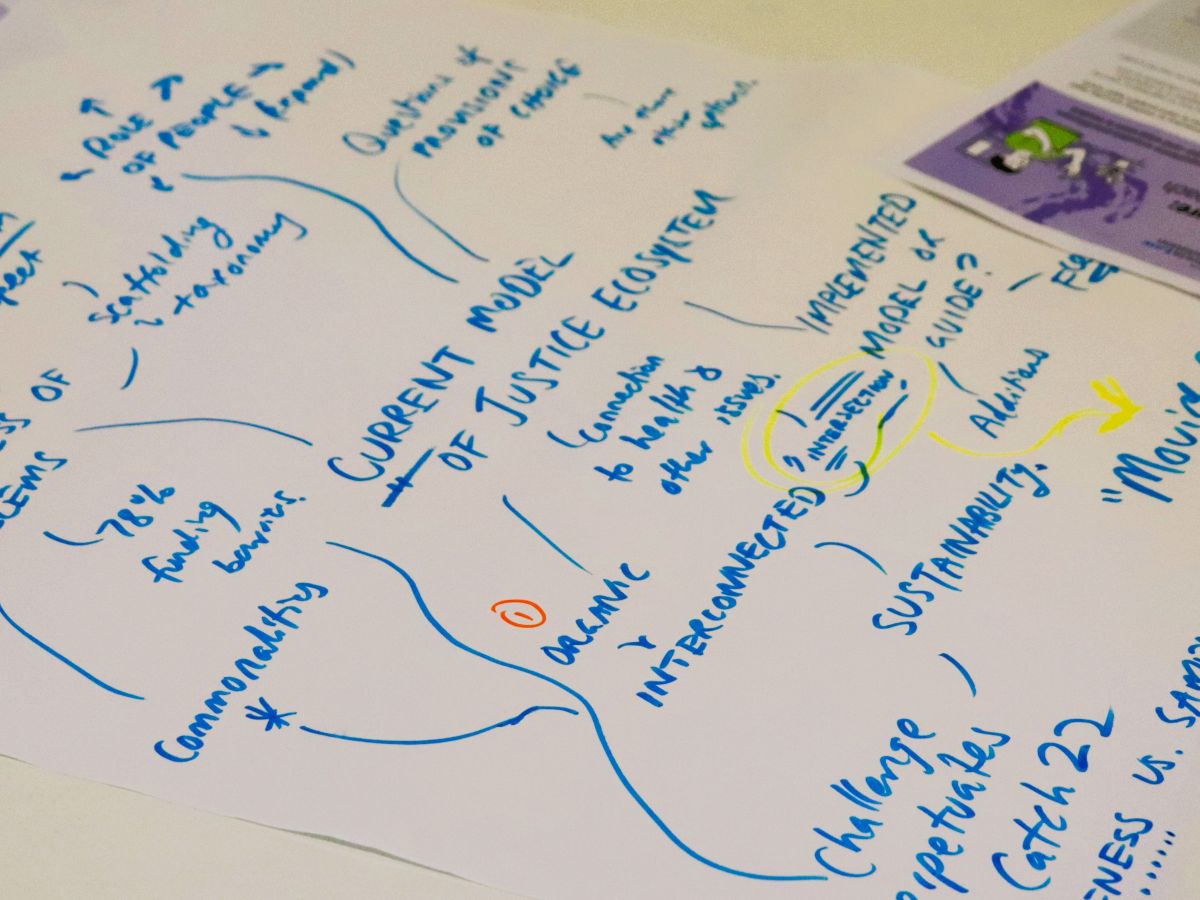
The ecosystem
Thinking of the justice system as an interrelated, co-dependent web seems so self-evident it’s startling to be describing it as relatively new thinking. When it comes to the way the institutions of justice understand themselves however, it is pretty groundbreaking.
For reasons discussed in my previous musings, the well-established elements of our legal landscape concern themselves with their own functionality, as they should. The courts and legal assistance for example are focused on throughputs and efficiency, which, given we’re always operating in constrained circumstances, is entirely understandable. Greater attention however is now being paid to outcomes: what difference do these services make to the people who use them? This is harder to measure, and there’s always a risk it could lead to uncomfortable truths about long standing ways of doing business, but the change is coming.
When you start thinking outcomes (and the reasons for them) the net of consideration expands. Ecosystems are hard to define and to put funding/accountability fences around. But to anyone who has been working on how you help people resolve their (legal) problems, this more complex context is the reality and must become a framing for future policy and practice. How the sector responds, with ingenuity and resolve, is a discussion we’ll continue to have.
The intersection between the political moment and the way we consider justice is a fascinating one – a topic for another time – but my hunch is that many are waking up to the growing fragility of our democratic model, and the role the rule of law and access to justice play in our social contract. The connection between feeling unable to use the system to access justice and rejecting the whole damn democratic thing is becoming clear. It’s a demonstration of an interconnection, an ecosystem dare I say.
At the VLF we refer to the concept of the ecosystem in our most recent report, Measure for Measure, and look forward to many conversations in this direction at our forthcoming International Access to Justice Forum we’re hosting later this year with Monash Law School.
People-centred justice
Is people-centred justice a more fashionable restatement of access to justice? Well, in part. Access to justice is expressed as the experience of the client: how do I comprehend and navigate a system, overcome the barriers and wend my way to a fair outcome? People-centred justice (PCJ) is the institutional corollary: how do those at the front line ensure that services put the individual at the centre? This changes the thinking in a fundamental way: from what the institution wants to what the user needs from their justice system.
The relatively recent recognition of capability as a core dimension in access to justice (see Public Understanding of Law Survey Volume 2) is central to both: responding to variations in capability is critical to delivering PCJ, and having or building capability can be the difference between accessing justice or not.
Both our Measure for Measure report and the recent publication from the American Bar Foundation Access to Justice Initiative1, in their diverse ways, articulate and demonstrate the growing understanding around PCJ. Capability works hand in glove with the notion of a justice ecosystem, inherently recognising that people come with complexity and that any effective response must engage with the warp and weft of their circumstances.
This evolution in the framing of justice is vital, but once again, like the ecosystem concept, the popularisation of PCJ comes at a political moment which might stretch the distance between theory and practice. We need that golden triangulation of commitment from leaders, policy and practice competence, and sufficient resources, and of these three, only one is moving in a positive direction.
Access and justice
What do you understand by access to justice? When I talk to thoughtful, eminent jurists I’m struck over and again that their vision of A2J is actually A2C/L, access to courts and/or lawyers. In truth, getting to justice may or may not involve these institutions, and lawyers may or may not be handmaids in that process. While lawyers and courts are of course far more involved in criminal law, around 75% of people find their way to resolution of their civil legal problems through non-legal people and organisations (see Public Understanding of Law Survey Volume 1).
This goes again to the idea of the ecosystem – or a house. To labour my analogy, the modular lounges of courts and tribunals are reupholstered from time to time, but the high traffic areas round the rest of the joint indicate the reality of people’s paths to justice.
Over time there’s been a circumscription in the understanding of A2J for many, who focus on the access rather than the justice. The fractious and febrile times we live in, and basic human dignity, demand we spend as much time on the justice we’re providing access to. We need to understand the societal context that justice sits in (ecosystem) and whose interests it serves (PCJ).
Framing is critical. It shapes the parameters we set around policy and practice. The way we think about the extent and role of justice is changing, presenting a valuable opportunity to interrogate our systems and their impact.
Join us for the International Access to Justice Forum in Naarm/Melbourne in October, for illuminating discussion on many of these issues, and both halves of the phrase access AND justice.
Publications

We don’t really know what works – what makes a difference to people in their hour of legal need. We have an ecosystem and a culture which preferences some law over others, some people over others, so maybe we don’t want to know?

Getting better at justice requires all of us to think more broadly about how we can connect those dots in our work.

Subscribe to our Newsletter
An editorial from Dr Rebekah Farrell, Executive Director, Victoria Law Foundation.

Helping young people overcome some of the barriers on their way to achieving Australian citizenship.

Through the reflections of colleagues, collaborators and friends, this we celebrate Dr Hugh McDonald's extraordinary contribution to access to justice and the enduring influence of his ideas on research, policy and practice.

Respond to legal need
Major Grants offer up to $100,000 for civil legal projects that help organisations better understand and support the legal needs and capabilities of Victorians.